Ecosystem Update October 2026
We are pleased to share the October 2026 Ecosystem Update, highlighting developments in the macro environment, market performance, the broader industry landscape, and Advanced Blockchain’s ecosystem.
Macro Overview
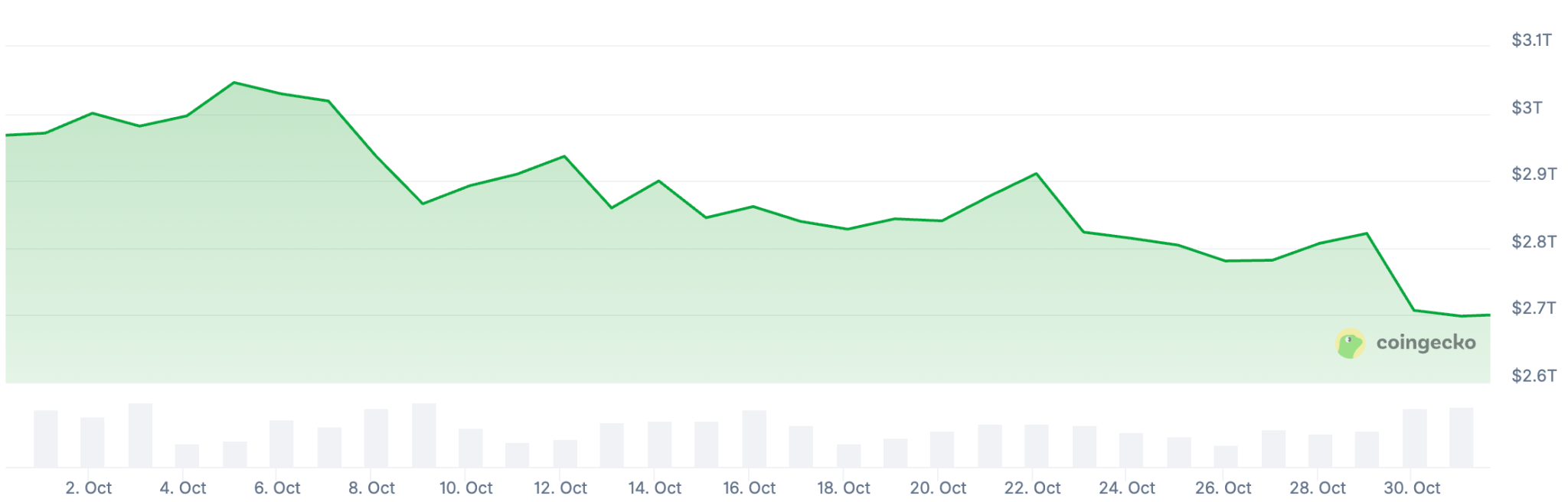
October's total market cap traced a staircase descent, with two sharp legs down separated by a prolonged mid-month consolidation. The month opened above $2.95 trillion and briefly crested $3.1 trillion around October 5-6, completing a recovery from June's $2.1 trillion trough and marking the first return to the $3 trillion level since late 2025. The first drop arrived on October 7-8, the same two sessions that saw $729 million in Bitcoin ETF outflows and the ESMA opinion requiring USDT delisting by January 8. What followed was an unusually flat 17-day plateau: from October 8 through October 26, the market oscillated in a narrow $2.8-2.9 trillion band despite constructive mid-month events including the October 21 OCC GENIUS Act final rule; the ceiling held because macro headwinds such as Strait of Hormuz oil price shocks, AI equity selloffs weighing on tech broadly, and 23 consecutive sessions of Ethereum ETF outflows. The second and steeper drop came in the final two sessions: the October 29 Binance hack of $6.36 billion triggered an immediate 5% Bitcoin selloff and $643 million in ETF outflows on October 30, erasing the entire remaining plateau in roughly 48 hours and closing the market near $2.65 trillion.
Bitcoin's Worst October Since 2016: -7.3% as ETF Flows Turn Negative
The "Uptober" seasonal rally narrative that had become consensus in crypto markets failed decisively in 2026. Bitcoin opened the month at approximately $83,554 and reached its monthly high of $87,249 on October 2, a continuation of September's late-month momentum. That peak marked the ceiling. Over the following four weeks, Bitcoin retreated in nearly every session, reaching its monthly low of approximately $76,141 on October 30 and closing at approximately $77,400. The broader market followed the same arc: total crypto market capitalisation briefly touched $3 trillion around October 2.
US spot Bitcoin ETFs told a conflicted story that eventually resolved to negative. The month opened with $102.7 million in net inflows on October 1, followed by two consecutive sessions of heavy outflows totalling approximately $729 million on October 7-8. A mid-month recovery peak arrived on October 19, when BlackRock's IBIT recorded a single-day net inflow of $665.2 million — its largest since October 2025, helping the aggregate BTC ETF complex post $526.6 million in net inflows for the session. On the same day, BlackRock filed with the SEC for the iShares Bitcoin Managed Protect ETF, a third Bitcoin product designed to give investors capped upside exposure to IBIT combined with a level of downside protection. The rebound proved temporary. A brief four-session inflow streak in late October was overwhelmed by a $643.3 million net outflow on October 30 as markets reacted to the news of the Binance hack. Cumulative net inflows since the January 2024 ETF launches remained positive at approximately $57.6 billion, with total AUM across all spot Bitcoin ETFs near $105.8 billion in mid-October.
Ethereum's ETF story was considerably worse. US spot Ethereum ETFs recorded their worst month on record, shedding approximately $1.61 billion in net outflows across at least 23 consecutive sessions of negative flow. The contrast between ETH ETF record outflows and the IBIT mid-month inflow spike suggests that institutional capital rotated within the crypto complex toward Bitcoin rather than exiting the sector.
Stablecoin regulation advancement: EU’s first “significant” crypto token and Asia’s practices in stablecoin integration
Europe spent October 2026 converting MiCA's stablecoin rules from framework into enforcement. On October 8, ESMA and the European Commission jointly published Opinion ESMA75-113276571-1742, addressed to national competent authorities, requiring all MiCA-authorised crypto asset service providers to stop facilitating new purchases of non-compliant asset-referenced tokens and e-money tokens immediately and to wind down existing client holdings by January 8, 2027. ESMA closed a widely anticipated loophole explicitly: risk disclosures, explicit user consent, and client acknowledgments do not make a non-compliant stablecoin service lawful under MiCA. The practical target of the opinion is Tether's USDT, which carried approximately $181.6 billion in global supply but has not obtained EU authorisation. The market impact is already visible: USDC, at approximately $71.3 billion in supply, now leads euro-denominated stablecoin trading on EU-regulated platforms, a structural shift driven by regulatory compliance rather than organic preference.
Six days after the ESMA opinion, USDC's regulatory standing advanced further. On October 14, the European Banking Authority classified Circle Internet Financial Europe's USDC as the EU's first 'significant' e-money token under MiCA's Articles 43 and 56, triggering a transfer of direct supervisory authority over USDC's reserves, liquidity plans, and redemption arrangements from France's ACPR to the EBA, effective November 12, 2026. This is the first live test of MiCA's tiered supervision model for e-money tokens, and the EBA's exercise of reserve-oversight powers will set precedents for how the 'significant' classification operates in practice for any large stablecoin that subsequently obtains EU authorisation.
International regulatory developments in October were spread across several jurisdictions. On October 12, FSB Chair Andrew Bailey published a letter to G20 finance ministers ahead of the Bangkok meeting on October 15, flagging cross-border stablecoin vulnerabilities and recommending three data-gap workstreams rather than new binding rules. In South Korea, the FSC chairman stated on October 22 that the Digital Asset Basic Act framework was in its final inter-agency consultation phase; one day later, the Bank of Korea announced plans to amend the foreign exchange law to treat stablecoins as payment instruments. In Hong Kong, the SFC approved the first secondary market trading of tokenised public money market funds on October 26, with ChinaAMC funds listed on the PantherTrade platform. And on October 23, HSBC launched RedCoin on its PayMe platform, reaching 3.3 million users and 100,000 merchants, making it one of the first HKD stablecoins issued directly by a global bank and a concrete signal of where traditional banking institutions see the stablecoin market heading.
AI Agents and Crypto Payment Rails: 138 Million Micropayments and an Anthropic IPO
On October 14, Chainalysis published data showing that autonomous AI agents had made more than 138 million x402 micropayments on Coinbase's Base blockchain in approximately 16 months. Ripple reported a separate 13 million x402 payments on the XRP Ledger over a comparable period. The pattern mirrors the infrastructure signal Cloudflare gave in August, when it launched Cloudflare Wallets specifically for AI agents using the x402 protocol; the Chainalysis data confirms that agents have been transacting at scale on exactly those rails throughout 2026. Solana added batch settlement for x402 in October to aggregate many sub-cent payments into single on-chain transactions, addressing the fee economics of high-frequency agent micropayments.
Six days after the Chainalysis report, the payment infrastructure layer expanded further. On October 20, Mastercard opened early access to its AI agent payment service, following pilots conducted with Coinbase, Base, and Cloudflare. The integration bridges Mastercard's global merchant acceptance network with the x402 crypto payment rails that AI agents currently use, meaning an agent can in principle make a payment to a traditional merchant or service provider without requiring that merchant to directly handle cryptocurrency.
The same week, the AI sector's largest public market moment arrived. On October 26, Anthropic filed its public S-1 registration statement with the SEC, targeting a Nasdaq listing under the ticker ANT with Goldman Sachs as left lead underwriter and Morgan Stanley and approximately 20 other banks in the syndicate. The company did not disclose the offering size or price in the S-1, but Bloomberg and other sources reported a target of approximately $100 billion to be raised at a speculated valuation near $2 trillion. The Anthropic IPO is relevant to the crypto space on multiple levels: Claude models are widely embedded in the AI agent frameworks generating the x402 payment volume described above; Anthropic's entry into public markets validates the AI sector that is now generating computable demand for crypto payment rails; and the IPO creates a publicly traded benchmark for the AI-as-infrastructure thesis. For the crypto industry specifically, the IPO is both a competitor signal (centralised AI infrastructure at scale) and a validation signal: if the largest AI safety company is going public at a valuation equivalent to roughly 65% of Bitcoin's entire market cap at October month-end, the economic significance of the AI-crypto infrastructure layer that intersects them is no longer speculative.
Solana Update Alpenglow Goes Live
October 21, 2026 proved a decisive divergence point for the two largest smart contract platforms. At approximately 13:36 UTC, Solana's Alpenglow consensus upgrade activated on mainnet at the start of epoch 1064, completing the handoff from TowerBFT in 900 milliseconds with 654 validators participating. Alpenglow replaces TowerBFT's Optimistic Confirmation with Votor, a new consensus protocol targeting transaction finality of approximately 150 milliseconds versus the prior average of roughly 12.8 seconds, a reduction of more than 98%. Early dashboard readings on activation day showed measured finality of 6.6 seconds at 4,721 TPS, reflecting a network stabilising under new consensus rules in its first epoch. The Solana Foundation characterised the 150ms figure as a target expectation rather than a constant, acknowledging that real-world performance depends on validator distribution and network load. The upgrade also improves fault tolerance: the network can now maintain consensus with up to 40% of staked validators offline.
Group Update
The 2026 audit timeline is now taking shape. Both audits, for Incredulous Labs and Advanced Blockchain AG, are expected to be concluded by mid-April 2027. Preparations and first audit procedures are already taking place. The aim remains to keep the reporting calendar predictable and to hold the 2027 AGM earlier than in previous years, giving shareholders more timely information.
Preparation for the Eigenkapitalforum is ongoing. The event provides an opportunity to present the updated group strategy to investors and other capital market participants. The team is currently working on how to communicate the strategy’s priorities, the progress made so far and the next steps for the group in a clear and structured way.
Development of the Nutrivo scan-to-earn app continues. The team is currently finalising the open points relating to the technological capabilities required for the MVP stage, with a first prototype planned for the end of the year. The prototype will be the first version tested in practice, initially with a small group of testers and then gradually extended to a wider group. The collected feedback will guide the next stages of development.
For ABX Analytics, the team remains in contact with the relevant bodies following the submission of the Forschungszulage application and is awaiting feedback.
Portfolio Update
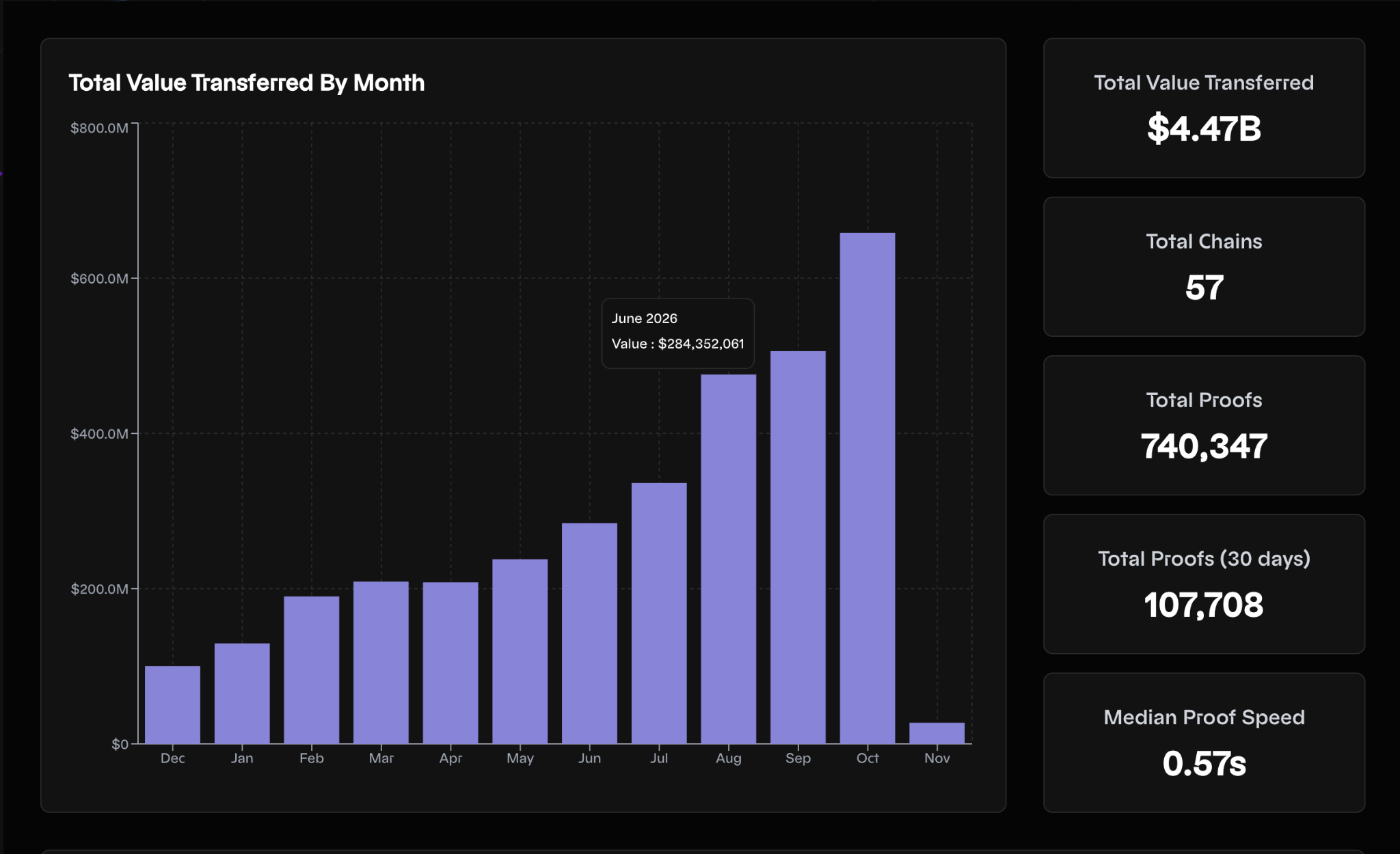
Polymer - Polymer Network kept moving across chains at record speed. October volume passed $650 million creating a new monthly high. That beat September’s previous high of $505 million and made it the fourth record month in a row.
About one out of every three dollars now travels through “intents,” which let solvers find the fastest route. Large single transfers, including a $20 million move from Ethereum to Arbitrum, settled fully and with no loss. All of Li.Fi’s intent volume also settled on Polymer.

Silencio - People from more than 180 countries are recording their voices so AI can learn real speech. The network now has over 2.5 million contributors.
They shared new test results showing how poorly some AI models understand Filipino-accented English. Error rates ranged from about 11% to nearly 45% on the same test. They also released real Kenyan Swahili samples recorded by everyday speakers and called for more Uzbek recordings on Language Day.
Near the end of the month they ran the usual monthly raffle for $SLC rewards and began updating their listings on major tracking sites.

Peaq - 2.5M+ robots and machines have bonded 17.2M+ $PEAQ. New tools let robots prove they are real hardware owned by a real business. The first 1,000+ processors from Acurast went live and more are coming.
A partnership with EintrachtTech started testing machine services inside football stadiums. Robots can now talk to building systems through Korea’s Mobius platform.
Machine.fun launched so anyone can fund real robots and machines from day one. Every machine that activates on it bonds PEAQ. Extra DualMint air-conditioning units also went live in a Hong Kong hotel, paying investors from energy savings.
Panoptic - This month three ready-made options vaults opened to more users after deposit limits were removed. The interface also got cleaner so people can see strategies and track results easily.
They launched a new monthly podcast called The DeFi Desk that explains volatility trading in plain terms. Posts also showed how normal Uniswap liquidity positions already act like covered calls, and how people can hedge them with options.

Teneo - The team spent most of the month preparing for the token launch (TGE), still planned for later in 2026 with no fixed date yet.
They paid out $8,000 in rewards to people running Beacon nodes. A community update confirmed the network, CLI, and bandwidth-sharing tools are running as normal.
On the business side, focus moved to companies that need reliable live-web data under clear service agreements. Most new demand is coming from small and mid-sized firms that pay by normal methods (bank transfer or card). Early testing with one very large company also started. The team is now packaging a public beta of the improved service for later in the year.
Closing Remarks
October was a month of two halves for crypto markets. Total market capitalisation briefly crested $3 trillion in the first week, then slipped into a prolonged consolidation before the Binance hack on October 29 pushed it to close the month near $2.65 trillion. Bitcoin had its weakest October since 2016, with US spot ETF flows turning negative at month-end and Ethereum ETFs recording their worst month on record. Beneath the price action, the regulatory and infrastructure story kept moving. In Europe, ESMA’s opinion on non-compliant stablecoins and the EBA’s “significant” classification of USDC moved MiCA from framework into enforcement, while the OCC’s final GENIUS Act rule gave US stablecoin issuers clearer ground. At the same time, AI agents continued to build real demand for crypto payment rails, with over 138 million x402 micropayments on Base and Mastercard opening early access to its AI agent payment service. Solana’s Alpenglow upgrade also went live on mainnet.
For Advanced Blockchain, the focus remains on delivering the group strategy. The 2026 audit timeline is taking shape. Preparation for the Eigenkapitalforum is ongoing. Nutrivo is finalising the technological capabilities relevant for the MVP stage, ahead of a first prototype planned for the end of the year, and the Forschungszulage application for ABX Analytics awaits feedback..
The portfolio continued to build through a weak market. Polymer set a fourth consecutive monthly volume record, passing $650 million. Peaq saw over 2.5 million machines bonding $PEAQ and launched Machine.fun. Panoptic opened its options vaults to more users after removing deposit limits. Silencio’s network grew past 2.5 million contributors, and Teneo advanced its preparations for the token launch. Together, these show projects continuing to build real usage regardless of market conditions. We look forward to sharing further progress in the coming months.
Best regards,
Your Advanced Blockchain Team


